
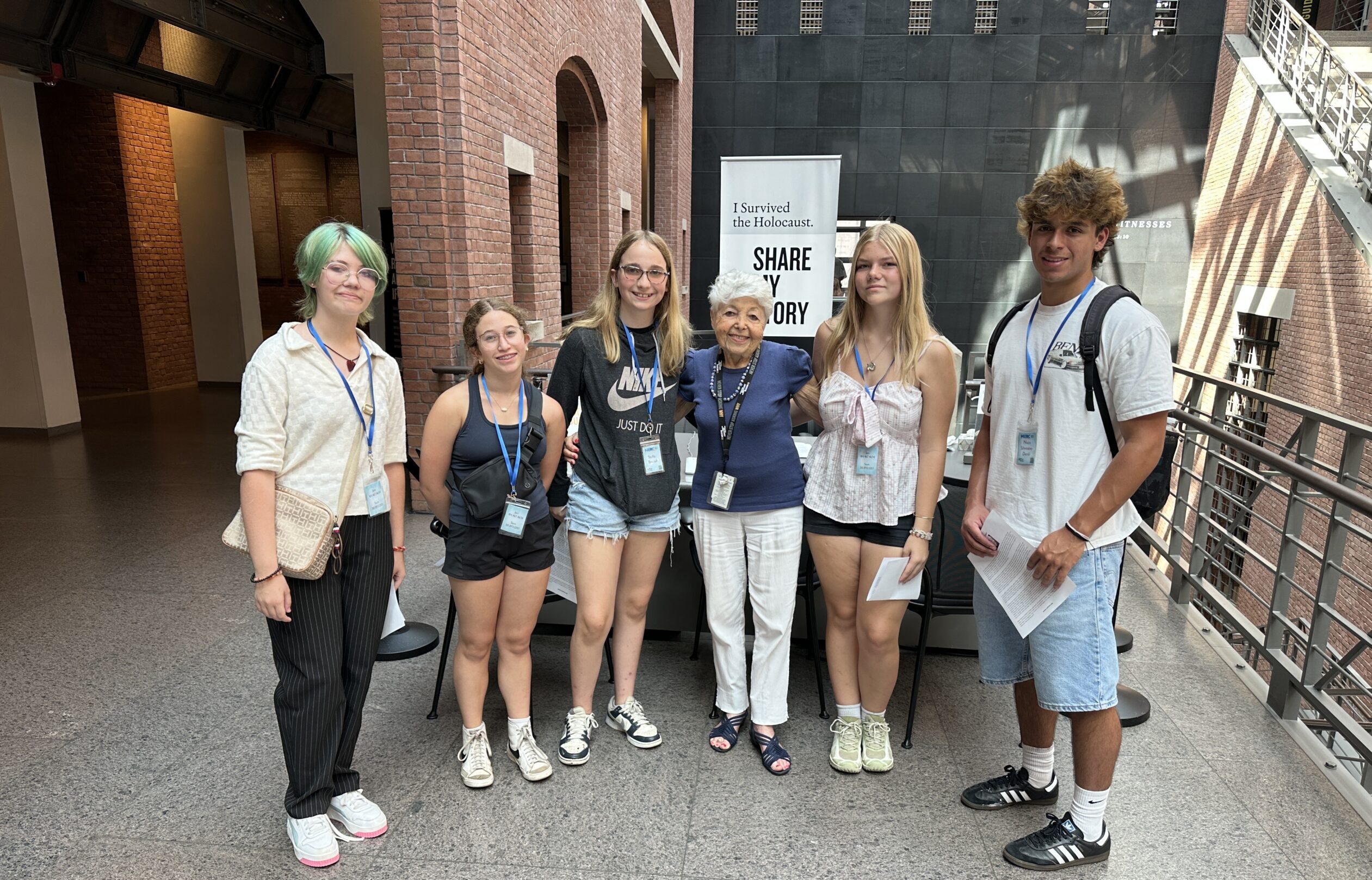
7-12 Students in Wisconsin
Holocaust Writing & Art Contest
Winners of the 2025 Holocaust Writing and Art contest in Washington DC
About the contest
The Harry & Rose Samson Family Jewish Community Center and the Nathan and Esther Pelz Holocaust Education Resource Center (HERC) are proud to partner each year on a contest that encourages middle and high school aged students to draw lessons from the Holocaust.
This contest is generously sponsored by The Mimi & Robert Habush Donor Advised Fund.
Eligible Participants
7-12th grade Wisconsin students
Prompt
How can we move beyond statistics to honor the individual lives impacted by the Holocaust?
Create a written or artistic piece that brings to life the story of a person affected by the Holocaust, showing their humanity, dreams, and identity beyond the numbers.
Original Writing or Art Entry Types
All works must be submitted digitally. All entries are limited to a single object (sculpture entries may include up to four images from different angles). Students may only submit one total entry.
- Original writing or art entry may be one of the following:
- Essay (not to exceed 3 pages, single-spaced – Works Cited pages do not count in the page count)
- Poetry (single poem, not to exceed 3 pages, single-spaced)
- Short Story (not to exceed 3 pages, single-spaced)
- Film/Video (maximum length: 5 minutes)
- Visual Art (painting, drawing, collage, digital art, etc.)
- Sculpture
- Comic Book
- Podcast/Social Media (maximum length: 5 minutes)
Deadline
Friday, March 6, 2026 at 11:59 pm CST
*Only accepting applicants from Wisconsin students
Artists’ Statement
All entries must include an artist’s statement, 50-200 words, in which you identify your inspiration for the piece and the takeaway you would like the audience to have. Entries WILL NOT be judged without this statement. Students should not include their name or any personal information in this statement.
Judging Criteria
Each entry will be judged with the following criteria in mind and using this scoring rubric.
- Offers a clear lesson from the Holocaust and connects it to present day
- Presents accurate historical facts
- Reflects artistry and skill
- Demonstrates originality and creative representation of the theme
- Entries that are not on topic will not be scored
Prizes
There will be 4 grand prize winners, two in the writing category and two in the art category. These four grand prize winners will be taken to Washington DC to visit the United States Holocaust Memorial Museum. Teachers of the four grand prize winners will receive a $100 gift.
All winners will be featured on the website of the Nathan and Esther Pelz Holocaust Education Resource Center and in the Milwaukee Jewish Chronicle.
contest resources
Contest Guidelines
Poster
Scoring Rubrics
Teacher Resources
Holocaust Vocab
WI Holocaust Testimony
2026 Winning submissions
PROMPT:
How can we move beyond statistics to honor the individual lives impacted by the Holocaust?
Create a written or artistic piece that brings to life the story of a person affected by the Holocaust, showing their humanity, dreams, and identity beyond the numbers.
Writing Winners
“Three minds”
A Poem by Kaylin Liburd, 12th Grade at Arrowhead Union High School
“The weight of memories”
A Poem by Nico Silvestre-Denk, 12th Grade at Arrowhead Union High School
“why it is important to remember the holocaust”
An essay by Yael Steigmann, 8th Grade at Milwaukee Jewish Day School
Art Winners
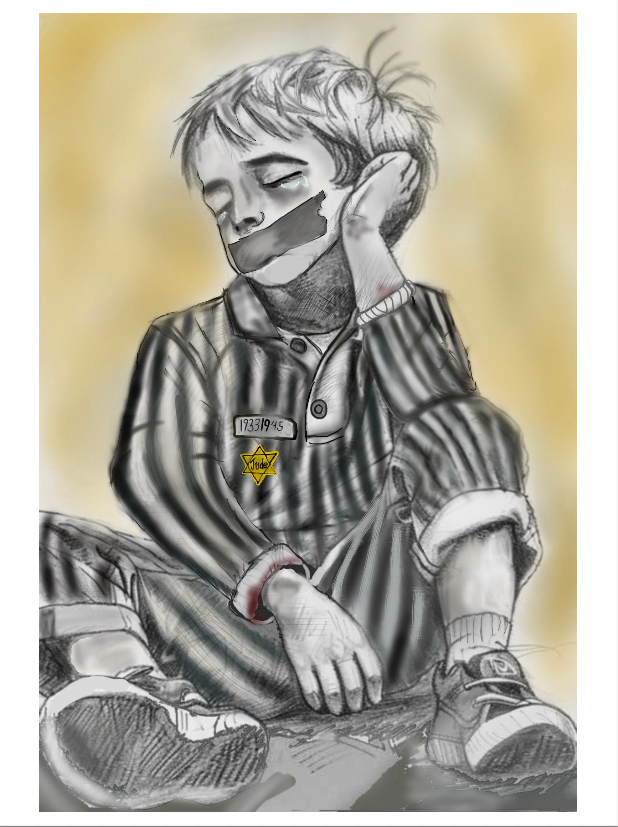
Artist Statement
“silenced survivor”
Stella Brandt, 8th Grade at Shorewood Intermediate School
This artwork grapples with the Holocaust, the systematic state-sponsored persecution and murder of six million Jews by the Nazi regime and its collaborators. My inspiration stems from the vital need to ensure this horrific event is never forgotten and stories of the silenced survivors are never forgotten. The person you see in the art piece with duck tape over their mouth symbolizes how victims were often silenced. Remembering the Holocaust honors the victims and forces us to confront the dangers of unchecked hatred and intolerance. Why remember? Because the past informs the present. Studying the Holocaust allows us to recognized warning signs of genocide and human rights abuses, empowering us to act against injustice and build a more better future. Remembrance shapes our understanding, guiding us toward a world where such atrocities are unthinkable. The Holocaust’s lessons are stark and enduring: the fragility of human rights, the peril of indifference, and the critical importance of confronting discrimination. These lessons remain tragically relevant in our world where human rights violations, ethnic conflicts, and extremist ideologies persist. By learning from the past, we can strive towards a future free from such horrors. This is a call to action not a suggestion.
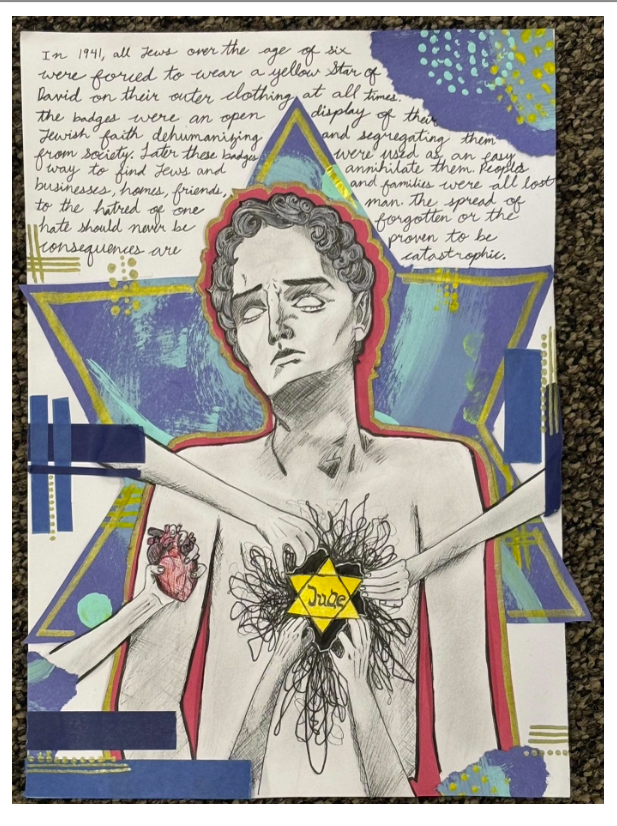
Artist Statement
“branded”
Kyla Jones, 8th Grade at Phillips Middle School
My piece was inspired by a combination of events and artwork. The hands reaching into the chest are inspired by David Altmejd’s sculpture The Healers, and David D’angers’s sculpture Sorrow inspires the face. The event that inspired this work was Germany forcing Jews to wear the stars because it was one of the first physical representations of their separation in parts of society. I made this piece to represent the dehumanizing Jews went through during the Holocaust. The man in the drawing is having his heart and soul ripped from him, and he has a yellow Star of David badge covering the hole in his chest, representing how the Jews had everything taken from them and were treated as inhuman because of their religion. I left the figure’s eyes blank because although I wanted to show as much emotion on his face as possible, I didn’t want him to look like anyone in particular. The man isn’t a real person but a representation of an entire people who were forced into labor, imprisoned, and killed in ways that no one should ever have to endure. He represents their memory and why the Holocaust should never be forgotten or repeated.
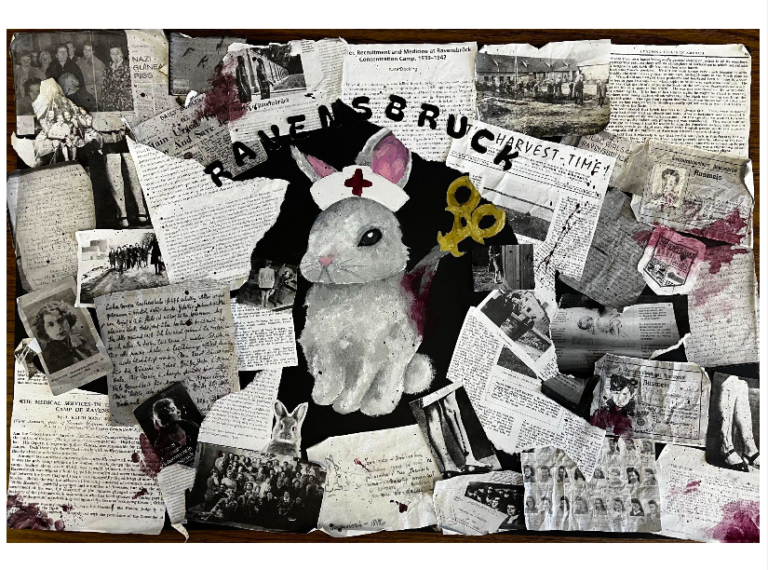
Artist Statement
“innocent to the eye”
Lila Mashuga, 8th Grade at Osceola Middle School
It’s important to never forget the horrors that happened to millions of innocent people during the Holocaust. Forgetting the Holocaust is a great disrespect to the millions who lost their lives or to those who lost their loved ones. The inspiration of my art project was the concentration camp Ravensbruck. I chose to do this art piece of Ravensbruck because as soon as I started looking into it for a school project, I could immediately tell all the horrors and experiments that happened at that camp. What I want people to take out and focus on most about this art piece is how the rabbit in the middle represents how innocent Hitler made the concentration camps out to be but the blood and the scissors stabbing the rabbit show the horrors and experiments that happened behind the walls of not only this camp, but all the other concentration and death camps. The rabbit also conveys the Ravensbruck rabbits, who were also a big part in Ravensbruck during the Holocaust because they were the ones who were experimented on and who tried to help all the injured in the camp.